
Most businesses treat their website as a project.
You scope it, design it, build it, and launch it. And then you move on to the next priority—SEO, paid ads, email—as if these are separate initiatives that happen to share a URL.
That’s backwards. And the cost of that thinking shows up everywhere: in SEO performance that plateaus, in paid campaigns with high cost-per-click and low conversion rates, in leads that come in unqualified, and in tracking so fragmented you can’t tell what’s actually working.
Your website isn’t a destination. It’s the central hub for every marketing channel. And if the structure was designed for aesthetics rather than for the marketing system it needs to support, every dollar you spend on SEO, ads, email, and social is working harder than it has to, with less to show for it.
This is what integrated marketing website design actually means, and here’s how to build it.
The Silo Problem: When Your Website Doesn’t Talk to Your Marketing
Here’s how most service business websites get built:
A designer builds the site with a visual focus. Later, an SEO specialist comes in and immediately starts identifying structural problems. Later still, someone sets up paid ads and realizes the service pages don’t work as landing pages. A tracking consultant gets involved and discovers the analytics setup can’t attribute revenue to the source.
None of these people talked to each other during the build. Each one is solving a different version of the same problem after the fact, working around a foundation that wasn’t designed with them in mind.
The result: your site doesn’t support SEO well, it reduces paid ad performance, and tracking is a mess. Every marketing channel is fighting against the website instead of being supported by it.
The Five Structural Decisions That Impact Your Entire Marketing System
If you want to “win” at marketing, you need a marketing engine where each component is designed to work together from the start. No more silos, guesswork, or chasing tactics. Just a single system that adapts, converts, and compounds over time.
Getting there starts with understanding the five structural decisions that either connect your marketing or keep it fragmented.
Decision #1: URL Structure
URL structure is one of those decisions that seems minor until it isn’t. It affects SEO hierarchy, paid ad segmentation, and analytics reporting simultaneously. Unfortunately, a structure built purely for aesthetics creates downstream friction in all three.
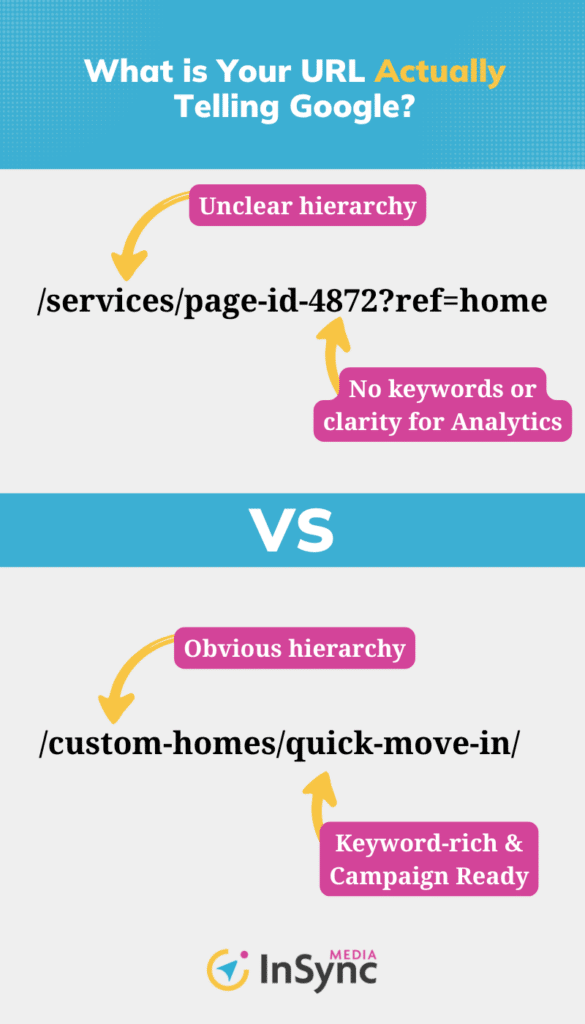
The silo approach:
URLs are whatever the designer or CMS defaulted to. Your SEO specialist later complains that the structure doesn’t support rankings. Your ads manager builds separate landing pages because the existing URLs don’t map to the campaign structure. Reporting is a mess because URL patterns don’t align with services or campaigns.
The integrated approach:
URL architecture is designed before a single page is built, with three purposes in mind simultaneously: SEO hierarchy, campaign segmentation, and analytics clarity.
The integrated URL is keyword-rich and hierarchical for SEO. It works as a dedicated landing page for an emergency service ad campaign. And in analytics, it’s immediately clear what’s being measured, no decoding required. One decision, three problems solved.
Decision #2: Landing Pages vs. Service Pages
The conventional approach separates service pages (built for SEO) from landing pages (built for ads). The logic seems sound until you realize the problems it creates.
Two pages targeting the same keywords compete against each other in search results, diluting their authority. You now have twice as much content to maintain, increasing the risk of inconsistent messaging. Link equity is split. And a visitor who encounters both—from organic search and then a retargeted ad—may see contradictory positioning.
The better-structured approach is a hybrid page that serves both purposes. The top section is optimized for paid traffic: a clear headline, an immediate CTA, trust signals above the fold, and no distracting navigation. The middle section provides the depth that earns organic rankings: comprehensive content, FAQs, internal links, and keyword coverage.
One page. One URL accumulating link equity. One set of messaging to maintain. Consistent experience regardless of how the visitor arrived.
There are certainly reasons to build a dedicated ads landing page, such as testing out different offers for specific ad campaigns. Our point here is that we do not necessarily default to building ads landing pages when the service page should be built to convert website visitors.
Decision #3: Navigation
Navigation design sits at the intersection of three competing priorities: user experience, SEO crawlability, and ad conversion. Each wants something slightly different, and a navigation built for only one of them creates friction for the others.
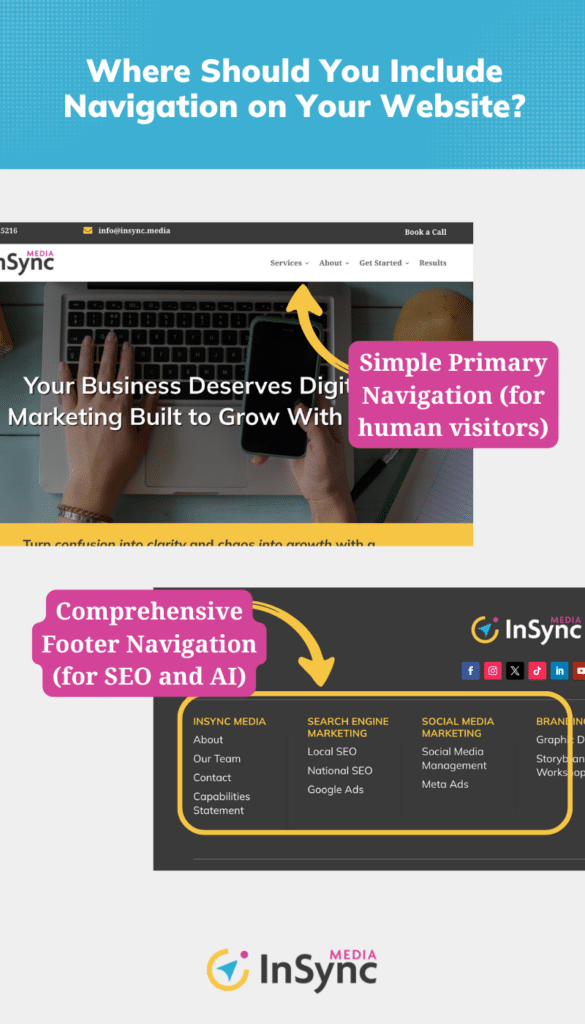
SEO wants every important page linked from the main navigation for crawlability. Good design wants a clean, minimal navigation that doesn’t overwhelm visitors. Paid ad conversion wants the option to suppress navigation entirely on landing pages, to reduce exit opportunities.
The integrated solution separates these concerns deliberately:
- A simplified primary navigation for human visitors (five to seven items maximum, conversion-focused hierarchy)
- A comprehensive footer navigation for SEO (full site hierarchy that search engines can crawl without cluttering the primary experience)
- The ability to suppress navigation on paid landing pages, keeping the visitor’s attention on a single conversion path
This structure satisfies all three requirements without compromise. However, it’s only possible if you’ve thought through the website hierarchy best practices before building, not after.
Decision #4: Content Strategy
In a siloed approach, content is created to serve one channel at a time. The blog exists to do SEO. Email campaigns are written independently. The sales team has no idea what content exists. Each piece is created in a vacuum with no connection to the others.
In an integrated structure, content is mapped to the buyer journey first, and then distributed across channels. A blog post that answers a question buyers ask during the consideration phase can serve as SEO content, an email-nurturing resource, a sales team reference, and a social post—all from a single piece of work.
What that flow looks like in practice: a prospective customer searches “how long does HVAC installation take?” They land on a blog post that answers the question helpfully. The post closes with a lead magnet: an HVAC installation timeline and cost guide they can download. They enter an email sequence that walks them through what to look for in a contractor. The sequence closes with an invitation to schedule a free consultation. When the sales team takes that call, they reference the same content the prospect has already read.
This is content working as infrastructure, not as a collection of disconnected posts that happen to share a website.
Decision #5: Tracking & Analytics Infrastructure
Tracking infrastructure is the decision that gets deferred most often. Yet it costs the most when it is. The common sequence: build the site, add Google Analytics as an afterthought, launch paid campaigns with tracking bolted on retroactively, and eventually realize you can’t tell which channels are producing revenue versus which are producing activity.
When tracking is planned before the site launches, the picture is completely different. Every page is tagged with its purpose, service line, and campaign intent. Every lead type—form submission, phone call, chat inquiry, email click—has its own conversion event. CRM integration is built into the form structure so source data flows automatically. UTM parameters are standardized across all campaigns before the first ad is published.
The outcome: you know which marketing investments produce revenue, not just activity. You can compare ROI across channels with real attribution. You can identify what’s working and increase investment there, then kill what’s not before it wastes more budget.
Marketing should reduce decision fatigue, not add to it. A properly structured tracking system makes that possible because decisions are driven by data, not stress.
How Poor Structure Sabotages Every Marketing Channel
The downstream effects of a siloed website structure are specific and measurable across every channel you invest in.
How It Kills SEO Performance
When pages aren’t structured around a clear keyword hierarchy, they compete against each other for the same terms, splitting authority rather than building it. Weak internal linking means Google can’t determine which pages represent your core expertise. Generic URLs without keywords miss basic SEO-friendly website architecture. And without location-specific pages, you lose local search to competitors who deliberately built that structure.
How It Kills Paid Ad Performance
Pages with slow load times generate low Quality Scores in Google Ads, which raises your cost-per-click and reduces your ad position, meaning you pay more to appear less prominently than a competitor with a faster page. Landing pages that don’t match ad copy reduce relevance scores. URL structures that don’t support segmentation make retargeting campaigns blunt rather than precise. And broken or incomplete conversion tracking means ad budgets are allocated based on which campaigns drive clicks rather than which ones drive revenue.
How It Kills Lead Quality
When visitors land on pages that weren’t built for their specific intent, bounce rates climb and qualification drops. Forms without the right qualifying questions attract contacts that waste your team’s time. CRM systems that don’t capture source data make it impossible to identify which channels bring your best customers, so you can’t scale what works. And generic follow-up sequences that treat all leads the same miss the opportunity to tailor the conversation to where each prospect actually is in their decision process.
How It Kills Email and Nurture Performance
Without lead magnets or mid-funnel content offers, your email list only grows from visitors who are already ready to buy—leaving the majority of your traffic uncaptured. Email sequences that aren’t connected to website content feel disconnected and generic. And without retargeting integration, visitors who leave without converting simply disappear, with no mechanism to bring them back.
Red Flags That Your Website Was Built in a Silo
If any of these patterns are familiar, your website structure is creating friction across your entire marketing system:
- Your SEO specialist regularly complains about the site structure and works around it rather than with it
- Your ads manager built separate landing pages because your service pages don’t convert for paid traffic
- You can’t accurately tell which marketing channels produce actual revenue—only which ones produce clicks or form fills
- Different vendors blame each other when results underperform
- Every marketing channel feels like it’s operating independently rather than as part of a unified system
- You’ve added marketing tactics over time without a plan for how they connect
The Marketing Engine Build Process: How to Structure for Integration from Day One
Whether you’re building a new site or evaluating what to fix on your current one, here’s the sequence that produces an integrated structure:
- Map the buyer journey before building any pages. Identify the questions your buyers ask at the awareness, consideration, and decision stages. Determine which channels drive traffic at each stage. Design the site structure to support the full journey, not just the moment someone is ready to book.
- Plan URL architecture for SEO, ads, and tracking simultaneously. Keyword research informs the hierarchy. Service and location structures support local SEO. URL patterns are designed to enable campaign segmentation from the start.
- Design hybrid pages that serve organic and paid traffic. Top section for high-intent paid visitors. Middle section for research-stage organic visitors. One page, one URL, multiple purposes.
- Build conversion paths for every traffic source. High-intent visitors from ads or branded search get immediate, clear conversion options. Research-stage blog readers get lead magnets and educational offers. Return visitors from retargeting get progressive CTAs that acknowledge their prior visit.
- Implement tracking before launch, not after. Every conversion type has its own tracking event. CRM integration is built into the form structure. Call tracking is set up by source. UTM parameters are standardized before the first campaign goes live.
- Build a content strategy that feeds all channels. Blog content supports both SEO rankings and email nurture sequences. Service pages are optimized for both organic and paid traffic. The content calendar aligns with the sales process, not just keyword opportunities.
The Integrated Team Structure That Actually Builds This Way
The reason most websites end up siloed isn’t incompetence. Instead, it’s due to the series of handoffs between specialists who are never in the same room.
The designer finishes, hands off to the developer. Developers hands off to SEO. SEO raises concerns the designer never anticipated. Someone sets up ads and finds the pages don’t support the campaign structure. Tracking is added retroactively by yet another person who wasn’t involved in the build.
Integrated website design—design that actually functions as a marketing engine—requires that the designer, SEO specialist, and media buyer are in the same planning conversations before a single page is built. Not sequential reviews. Not post-launch feedback. Active collaboration during the structural planning phase.
When those conversations happen upfront, the questions that surface are different: “Does this navigation structure support crawlability without hurting conversion?” “Do these URLs work for both SEO hierarchy and campaign segmentation?” “If we suppress navigation on paid landing pages, does that conflict with the site architecture we’re building?”
Our role is to make sure everything works together to support visibility and growth.
What to Do Next
Start with an honest audit of your current structure. Work through these questions:
- Does your site structure support all of your marketing channels, or does each channel fight against it in a different way?
- Can you track from the marketing source to the closed deal, or only to the form submission?
- Do you have hybrid pages that serve both SEO and paid traffic, or are you maintaining two separate sets of pages?
- Is your URL structure keyword-rich and hierarchical, or does it default to whatever your CMS uses?
If you’re planning a redesign, the most important thing you can do is bring SEO, ads, and tracking into the planning conversation before a single wireframe is built. The decisions made in those early conversations will either compound your marketing investment or create drag on it for years.
If your site is already live, identify the highest-impact fixes first: tracking infrastructure, hybrid page structure for your highest-traffic service pages, and URL optimization where your current structure is actively limiting SEO performance.