
Why “Pretty” Websites Don’t Bring in Sales, and What High-Performing Sites Actually Do Differently
You invested in a new website. The designer delivered something genuinely beautiful: a clean layout, strong visuals, and a color palette that finally feels on-brand.
And then… nothing changed.
Google isn’t ranking it the way you expected. AI tools don’t mention you when someone asks for a recommendation. The phone isn’t ringing any differently than it did with the old site. You got compliments from your team, and maybe a few clients, but the metrics that actually matter (revenue) haven’t moved.
This is one of the most expensive misunderstandings in service business marketing: the belief that a great-looking website is a high-performing website. They’re not the same thing. In fact, the features that make a site visually impressive often conflict with the technical requirements for search visibility and conversion.
So, what’s actually missing? What are high-performing sites doing instead?
The Core Problem: Design Agencies Build for Humans. Not for Algorithms.
Website designers are optimizing for the right thing—from their perspective. A visually compelling site wins portfolio awards, impresses other designers, and earns client approval during the reveal meeting. The problem is that none of those outcomes are what drives rankings, AI discoverability, or lead conversion.
Search engines and AI systems don’t see your site the way humans do. They don’t appreciate the hero image or the custom typeface. They’re reading the underlying structure: your schema markup, your page titles, your keyword alignment, your load speed, your internal linking architecture. A site that scores tens in the technical work AND in the visual design is rare, because most design agencies simply don’t work in that territory.
SEO and AI optimization aren’t in a design agency’s scope, so they don’t happen. What you end up with is a beautiful site that search engines can’t fully parse, and AI systems can’t confidently recommend.
If people can’t find your site, it doesn’t matter how pretty it is.
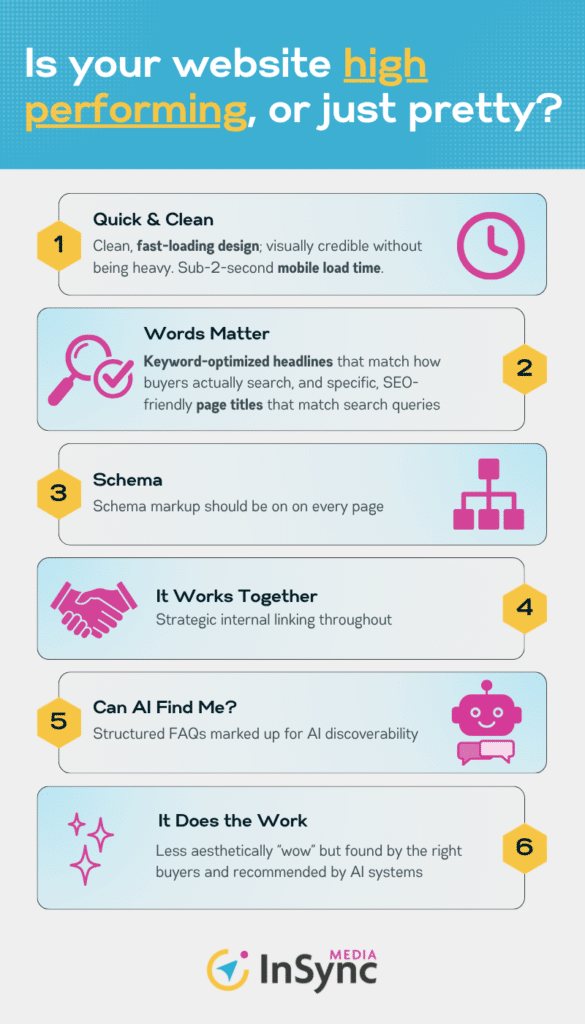
What High-Performing Sites Do to Dominate Search: Traditional and AI
The gap between a pretty website and a converting website comes down to a set of technical and strategic decisions that most design agencies never make. Here’s what those decisions look like in practice.
Optimization #1: Structured Data That Tells Google and AI Exactly What You Do
Schema markup is invisible to human visitors. It lives in the code beneath your pages and communicates directly with search engines and AI systems in a structured language they can reliably parse.
Without it, search engines and AI tools are making educated guesses about what your business does, where you serve, what your reviews say, and what questions you answer. With it, you’re telling them directly, which dramatically improves your chances of appearing in the right results.
AI tools like ChatGPT and Perplexity don’t invent answers out of thin air. They summarize and reference what already exists online. If your expertise isn’t clearly understood online, AI has nothing solid to reference. Schema markup is a core part of what makes a business citable in AI-generated responses.
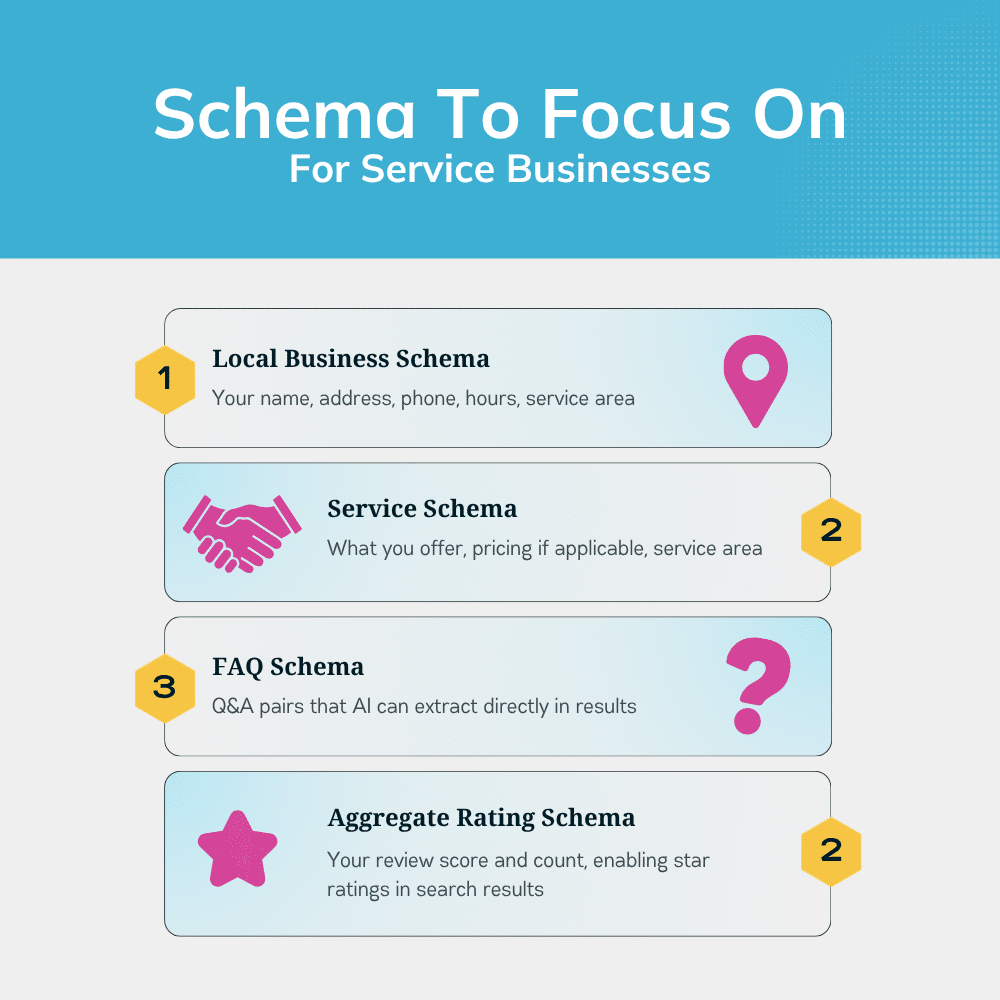
The schema types that matter most for service businesses:
- LocalBusiness schema: your name, address, phone, hours, service area
- Service schema: what you offer, pricing if applicable, service area
- FAQ schema: Q&A pairs that AI can extract and surface directly in results
- AggregateRating schema: your review score and count, enabling star ratings in search results
Pretty sites skip schema. High-performing sites implement it from day one as infrastructure, not an afterthought.
Optimization #2: Content Written for Search Intent, Not Brand Storytelling
There’s a real tension between design-led content and search-optimized content. Design-led copy tends toward poetry and brand voice: “Empowering your wellness journey.”
Search-optimized copy tends toward specificity and intent: “functional medicine for thyroid treatment in Denver” or “gated community for 55+ active adults in Dallas”
Search engines rank content that answers search queries, not content that sounds nice. And the buyers searching for your services are using specific, practical language: they’re not searching “wellness journey”—they’re searching “functional medicine thyroid Denver” or “emergency plumber near me.”
The website that uses buyer language in its page titles, headers, service descriptions, and URLs is the website that appears when that buyer searches. The website that prioritizes clever brand language is the one that doesn’t.
This shows up in the details: a page titled “Our Services” is invisible in search. A page titled “HVAC Repair & Installation | Grand Junction, CO” is the page that gets found when someone searches “HVAC repair Grand Junction.” The content is the same. The optimization is entirely different.
Optimization #3: Page Speed That Doesn’t Sacrifice Performance for Aesthetics
Google uses Core Web Vitals—a set of speed and performance metrics—as a direct ranking factor. A slow site ranks lower, even when its content is strong and its keywords are right.
The features that make websites visually impressive are often the exact features that kill speed. Video backgrounds, full-screen hero images at full resolution, custom animations and scroll effects, and heavy JavaScript libraries all add load time. On mobile, where more than 60% of searches happen, a one-second delay can meaningfully reduce conversion rates.
High-performing sites treat speed as a feature. Images are compressed without sacrificing visible quality. Code is minimized. Animations are used sparingly and only when they don’t affect load time. The goal on mobile is a load time under three seconds, and more ideally under two.
You can check your own site right now: Google’s PageSpeed Insights is free, and it will tell you exactly where your speed is failing and what it’s costing you in rankings.
Optimization #4: Internal Linking That Builds Topic Authority
Internal linking shows Google the depth and breadth of your expertise. When your service pages link to related services, and your blog posts link back to relevant service pages, you’re building a web of interconnected content that signals topical authority.
Design-led sites tend to minimize internal links because they can feel cluttered or disrupt the visual flow. But isolated pages (pages with few or no internal links pointing to or from them) send weak authority signals. Google struggles to determine their importance in the overall site structure.
A dental practice site, for example, should have internal links from the general dentistry page to cosmetic dentistry, from cosmetic dentistry to teeth whitening and veneers, and from each of those back to the appointment booking page. Blog posts answering common patient questions should link to the relevant service pages. This creates a structure that systematically guides both users and search engines through your expertise.
Optimization #5: Mobile-First Structure, Not Just Mobile-Responsive Design
Google now uses mobile-first indexing, which means the mobile version of your site determines your rankings more than the desktop version. This is a significant shift that many service businesses weren’t designed for before 2020.
Mobile responsive means your desktop design scales to smaller screens. Mobile-first means the experience was built with mobile behavior as the primary context, and desktop was the adaptation. The difference in conversion performance can be significant.
On a mobile-optimized site, critical information appears first without requiring scrolling, navigation is sized for touch rather than mouse clicks, forms are simplified to minimize typing, and CTAs are always available as the user moves through the page.
Optimization #6: Location-Specific Pages for Local Search Dominance
For service-area businesses competing across multiple markets, one of the highest-leverage optimizations is also among the most commonly skipped: dedicated pages for each city or region you serve.
A single “Service Area” page listing ten cities doesn’t rank well in any of them. Google rewards location-specific relevance, and a generic page signals generic relevance. A dedicated page for each city signals that you’re genuinely local to that market.
The key distinction is that these pages need to contain genuinely different content. They can’t be identical pages with the city name swapped. Duplicate content doesn’t rank. Localized content does.
How AI Search Changes the Game (and What High-Performing Sites Are Doing About It)
AI-powered search is reshaping how buyers find service businesses. ChatGPT, Perplexity, and Google’s AI Overviews are increasingly the first places people go for recommendations, to compare options, and to validate their choices.
AI doesn’t care how pretty your site is. It cares about structure and authority.
A site that’s heavy on visuals and light on text gives AI systems very little to work with. A site built around clear, structured content gives AI systems exactly what they need to confidently reference your business.
The same things that build trust with humans—clarity, consistency, authority—also matter for AI.
Getting into AI Overviews and appearing in ChatGPT recommendations requires:
- Comprehensive, well-structured content that directly answers specific questions (not vague overviews)
- FAQ schema so AI can extract and surface your Q&A pairs without requiring a click-through
- Authority signals: structured reviews, credentials, third-party validation
- Regularly updated content
A practical test: search your primary service in ChatGPT or Perplexity and ask for recommendations. If you don’t appear, you have a structural visibility problem that no amount of design improvement will fix.
Side-by-Side: Pretty Website vs. High-Performing Website
Pretty Website:
|
High-Performing Website:
|
The Fix: Adding Search Optimization Without Ruining the Design
If you already have a website you like the look of, the good news is that most of these optimizations can be layered on without a full redesign. The structural improvements are largely invisible to visitors because they live in the code, the metadata, and the content strategy.
Here’s the order of operations that tends to produce the fastest results:
- Implement schema markup. LocalBusiness, Service, FAQ, and Review schemas don’t change anything visitors see, but they immediately improve how search engines and AI understand your site.
- Rewrite page titles and H1 headers with target keywords. Keep the design, just make the text work harder. “Our Services” becomes “HVAC Repair & Installation | Sacramento CA.”
- Optimize images and speed. Compress images, remove or reduce heavy animations, and verify your mobile load time is under three seconds.
- Add internal links throughout your content. Connect service pages to related services, and connect blog posts to relevant service pages.
- Build location pages if you serve multiple markets. One dedicated page per city or region, each with genuinely localized content.
- Add FAQ sections to service pages. Write the questions buyers actually search. Mark them up with FAQ schema for AI discoverability.
What to Do Next
Start with two free diagnostics that will tell you exactly where your site stands:
- Run your site through Google’s PageSpeed Insights (web.dev). It will score your speed on both desktop and mobile and tell you exactly what’s slowing you down.
- Use Google’s Rich Results Test to check whether you have any schema markup in place. If the answer is none, you’re effectively invisible to AI systems.
Then search your primary service in ChatGPT, Gemini, and AI Mode in Google. Ask for a recommendation as if you’re a potential customer. (Do this on a browser you normally don’t use or else you’ll get skewed results based on your browsing history.)